


Understanding Compliance in Chlorine Measurements
- Understanding compliance tolerances is important in assessing the health of your chlorine measurement system.
- Most systems follow the guidelines set forth in USEPA 334.0¹, which states that, when compared to a reference sample:
“Analyzer reading [must be] within ± 0.1 mg/L or ± 15% (whichever is larger) of grab sample measurement.”
Why Do Tolerances Exist In the First Place?
- Historically, chlorine measurements were made using colorimetric techniques, until amperometric technology became more reliable and popular.
- Since 2009, the EPA has judged the accuracy of amperometric technology using colorimetric techniques because they are so well defined.
- USEPA 334.0 builds in tolerances to account for inherent fluctuations and measurement errors that are present in both colorimetric and amperometric technologies.
Which Tolerances Should You Use?
- Determining which set of tolerances you will use depends on your chlorine concentration.
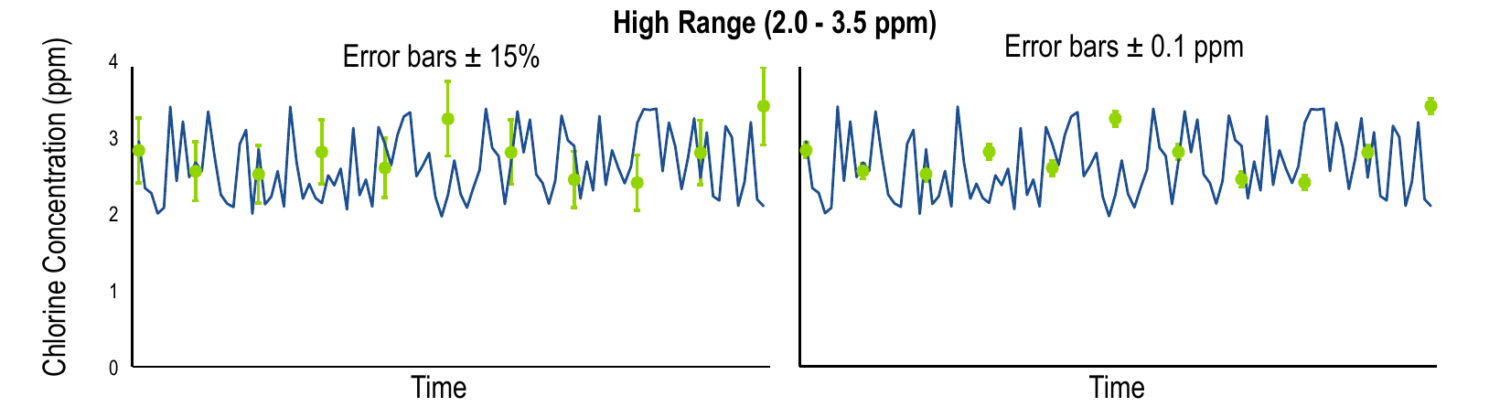
- To demonstrate this, we simulated some data, shown below.
- The analyzer signal is shown in blue, while reference measurements are shown by green circles.
- The error bars on the reference measurements show either ± 15% (left plots) or ± 0.1 ppm (right plots) of the reference value.
- To select the correct tolerance criterion, we will look at the relative size of the error bars on the circles.
Low and High Range Comparison
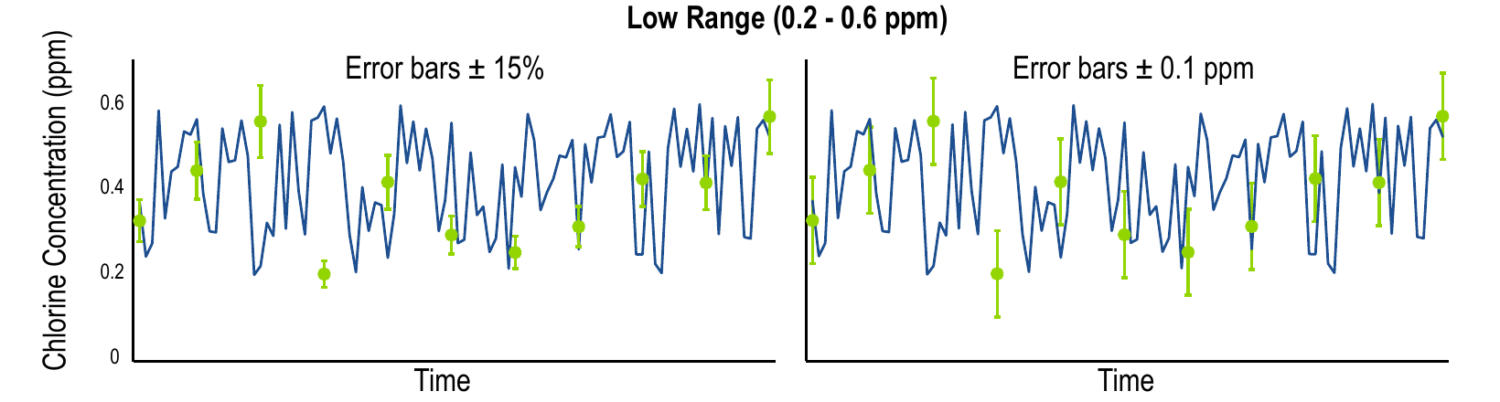
- In the low concentration range (shown above), the ± 0.1 ppm criterion is the accepted tolerance because its error bars are larger.
- In the high concentration range (shown below), the ± 15% criterion is the accepted tolerance because its error bars are larger.
If you have questions about compliance and how it applies to your system, please contact a Kuntze representative.
¹ U.S. Environmental Protection Agency. (2009). Method 334.0: Determination of Residual Chlorine in Drinking Water Using An On-line Chlorine Analyzer.