


Why pH Matters in a Free Chlorine Measurement
- When chlorine (Cl₂) is added to water, hypochlorous acid (HOCl) and the hypochlorite ion (OCl⁻) are formed.
- The term “free chlorine” refers to the combination of Cl₂, HOCl, and OCl⁻ that is present in solution.
- HOCl is the predominant biocidal agent, or what “kills” the pathogens that may be present.


How Amperometric Free Chlorine Measurement Works
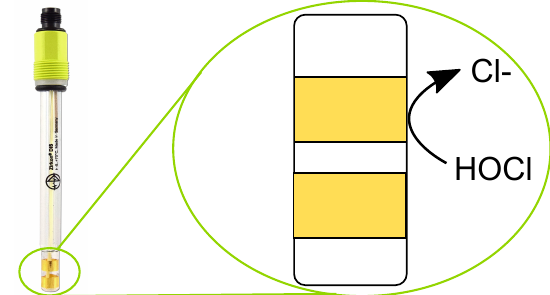
- All amperometric measurements of free chlorine, including the Kuntze measurement, measure only the presence of HOCl.
- HOCl is reduced on the measuring electrode, which yields a current that gets translated by the instrument to a free chlorine concentration.
Why pH Matters
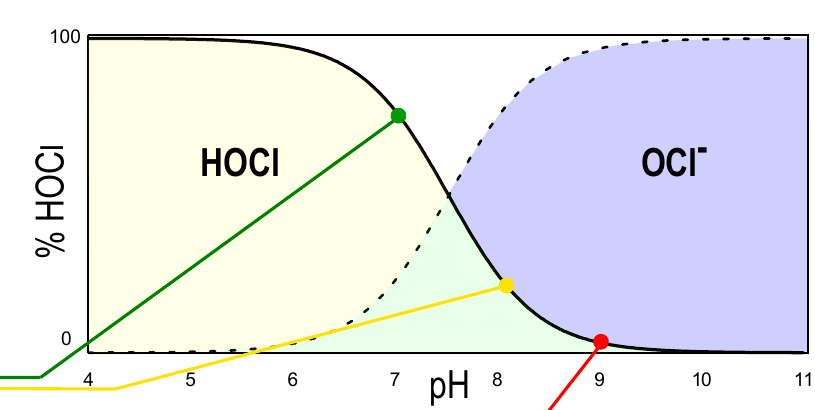
- The pH of the system determines what species are present, and in what ratio, shown in the chart above.
- Above pH 8, there is a very small amount of HOCl present in solution, making amperometric detection of free chlorine a more challenging process.
HOCl Concentration by pH
- pH = 7 — At pH = 7, the mixture is about 77% HOCl.
- pH = 8 — At pH = 8, the mixture is about 25% HOCl.
- pH = 9 — At pH = 9, the mixture is about 3% HOCl.
What This Means for Your Measurement
pH = 7
Your conditions are ideal for the Kuntze free chlorine measurement.
pH = 8
Keep an eye on your pH. If the pH further increases, the measurement may be affected.
pH = 9
Measurement at this pH will be challenging. Contact a Kuntze representative to discuss possible changes to your measurement system.