


Table of Contents
Do you need support?
Our team will be happy to assist you.
Understanding Compliance in Chlorine Measurements
This article summarizes how USEPA 334.0 applies to your chlorine measurement system.
Understanding compliance tolerances is important in assessing the health of your chlorine measurement system. Most systems follow the guidelines set forth in USEPA 334.0¹, which states that, when compared to a reference sample, “[analyzer] reading [must be] within ± 0.1 mg/L or ± 15% (whichever is larger) of grab sample measurement.”
Why Do Tolerances Exist In the First Place?
> Historically, chlorine measurements were made using colorimetric techniques, until amperometric technology became more reliable and popular.
> Since 2009, the EPA has judged the accuracy of amperometric technology using colorimetric techniques because they are so well defined.
> USEPA 334.0 builds in tolerances to account for inherent fluctuations and measurement errors that are present in both colorimetric and amperometric technologies.
Which Tolerances Should You Use?
> Determining which set of tolerances you will use depends on your chlorine concentration.
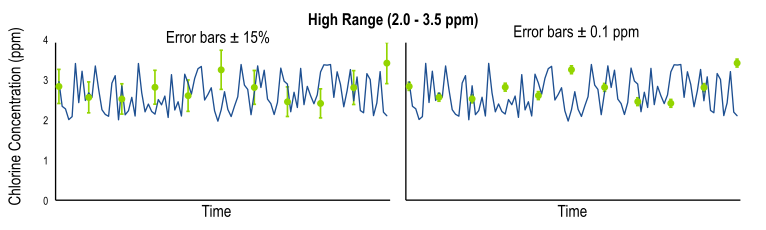
> To demonstrate this, we simulated some data, shown below.
> The analyzer signal is shown in blue, while reference measurements are shown by green circles.
> The error bars on the reference measurements show either ± 15% (left plots) or ± 0.1 ppm (right plots) of the reference value.
> To select the correct tolerance criterion, we will look at the relative size of the error bars on the circles.
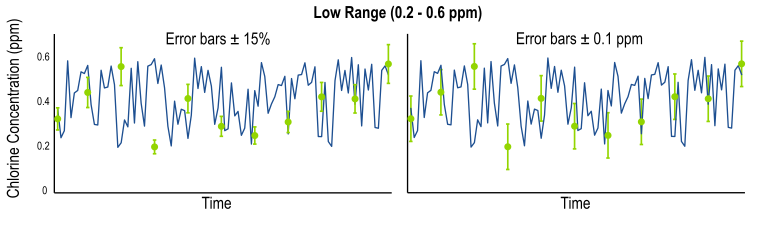 In the low concentration range (shown above), the ± 0.1 ppm criterion is the accepted tolerance because its error bars are larger. In the high concentration range (shown below), the ± 15% criterion is the accepted tolerance because its error bars are larger.
 If you have questions about compliance and how it applies to your system, please contact a Kuntze representative or submit a ticket.
1. U.S. Environmental Protection Agency. (2009). Method 334.0: Determination of Residual Chlorine in Drinking Water Using An On-line Chlorine Analyzer.